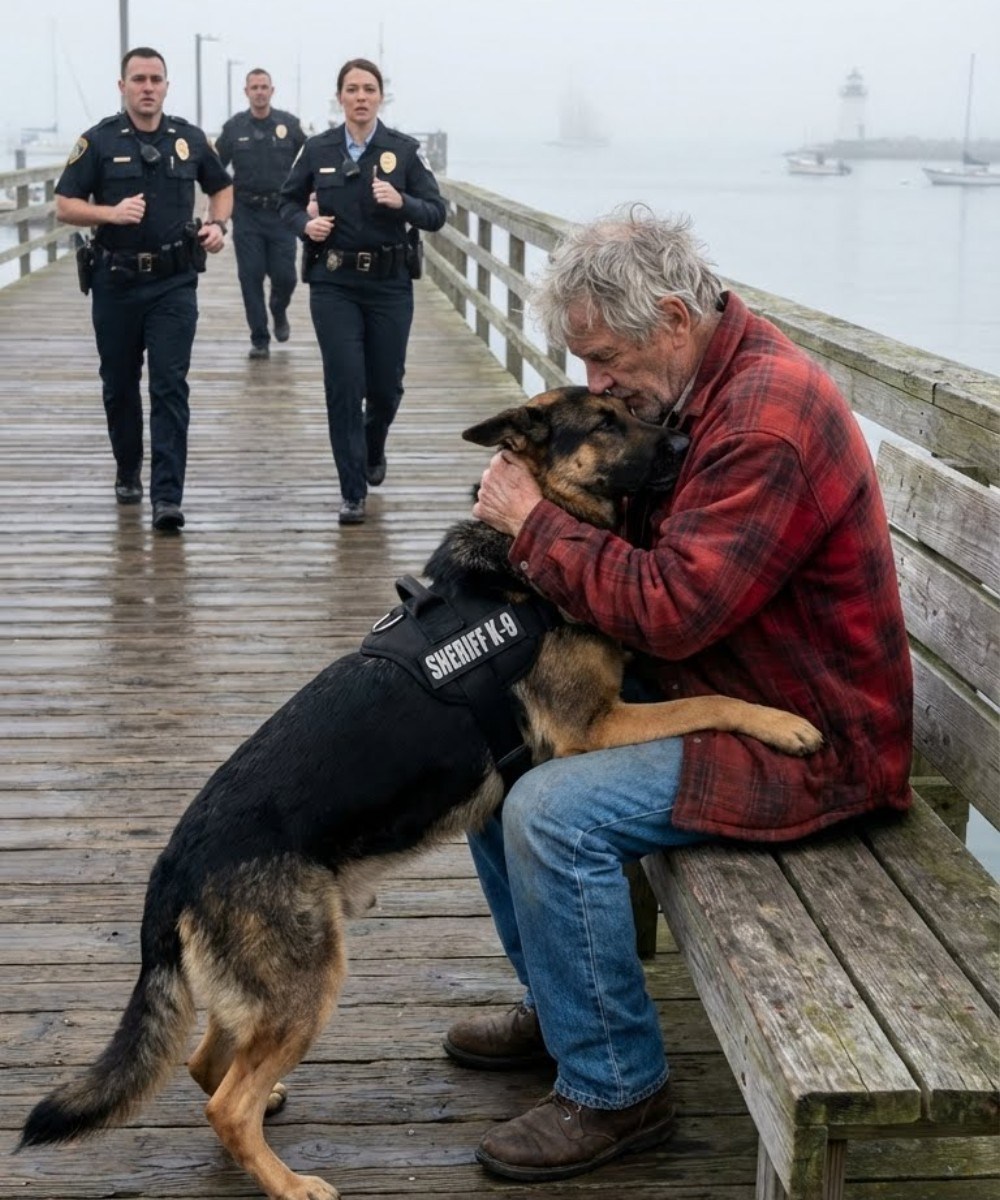
Un geste précis. Trop précis.
Don Ernesto porta une main à sa bouche.
« C’est moi… c’est moi qui lui ai appris ça », dit-elle en pleurant. « Quand j’avais des crises, quand je n’arrivais plus à respirer… il posait sa patte sur moi comme ça. Pour me ramener à moi. Pour me dire : “Me voilà.” »
Plusieurs agents ont eu les yeux qui piquaient sans autorisation.
Valeria baissa complètement son arme. Son visage, auparavant dur, s’adoucit, laissant transparaître une lueur d’humanité.
« Halte ! » ordonna-t-il à voix basse. « Baissez vos armes ! »
Les policiers hésitèrent un instant, car l’entraînement est une discipline difficile à rompre. Mais la scène qui se déroulait sous leurs yeux défiait toute logique : un chien d’intervention protégeant un homme âgé comme si sa vie en dépendait.
Mateo fut le premier à obéir. Puis un autre. Et encore un autre. Jusqu’à ce que le quai cesse de ressembler à un piège et commence à ressembler à… des retrouvailles.
Valeria fit deux pas vers Don Ernesto, désormais sans menaces, seulement avec des questions.
—Monsieur Salgado… pouvez-vous prouver votre implication dans cette opération ? Avez-vous des documents ? Un numéro d’unité ?
Don Ernesto hocha la tête en tremblant.
« J’ai… une vieille carte d’identité. Et un badge. Je l’ai toujours sur moi… » Il glissa la main dans la poche intérieure de sa veste, lentement pour ne surprendre personne. Il en sortit un badge usé et un sifflet en métal accroché à une lanière.
Dès que le sifflet retentit, le chien laissa échapper un gémissement faible, presque humain. Il renifla avec insistance, comme si le temps venait de se figer.
Valeria sentit un coup dans son estomac.
Car elle aussi avait un souvenir : celui de son père, un marin à la retraite, qui lui racontait l’histoire d’un chien qui avait jadis sauvé tout un peloton et disparu dans la fumée. « Je n’ai jamais su ce qu’il était devenu », dit-elle. « Mais s’il revient un jour… j’espère qu’il retrouvera celle qu’il aimait. »
Valeria prit une profonde inspiration, comme si sur ce quai se déroulait non seulement une évasion, mais aussi une histoire vieille de douze ans.
« Je dois faire les choses correctement », dit-il. « Par respect du protocole. Pour lui. Pour vous. »
Matthieu intervint avec douceur :
—Commandant, nous pouvons les emmener à l’unité pour évaluation. Mais… je ne pense pas que Delta acceptera de les séparer.
Le chien, comme s’il comprenait, se pressa de nouveau contre Don Ernesto.
Valeria s’agenouilla à la hauteur de l’animal.
« Delta », murmura-t-elle, puis elle changea de nom. « Ombre… si c’est ton nom… tu l’as bien mérité. Personne ne te fera de mal. D’accord ? »
Le chien la fixa du regard. Puis, lentement, il baissa la tête, non pas en signe de reddition, mais d’acceptation.
Don Ernesto laissa échapper un sanglot qu’il retenait depuis des années.
« Je croyais t’avoir perdu pour toujours », dit-il en serrant le cou du chien de tout son corps frêle. « Je me sentais vide, mon fils… je me sentais… sans ombre. »
Le soleil, enfin, commença à percer la brume. Des rayons dorés filtrèrent à travers l’air humide, et pour la première fois, la jetée ne parut plus grise : elle semblait neuve.
Hours later, at the police station, everything was confirmed. The scar matched military records. The dog’s microchip had been replaced when it entered the municipal program, but traces of an old number remained. And a signature, at the bottom of a lost document, read “E. Salgado” next to a note: “Exceptional handling and bond.”
Valeria walked towards Don Ernesto with a folder in her hand.
“Legally,” he said, “Delta belongs to the unit… but there’s also the option of retirement due to special circumstances and reassignment for the animal’s well-being. And this…” He looked at the dog, who hadn’t left the old man’s side for a second. “This is well-being.”
Mateo barely smiled.
“Besides, Commander… Delta escaped on his own. Nobody opened anything for him. He broke the cage, jumped the fence, and ran straight to the dock. As if he knew the way.”
Don Ernesto lowered his gaze, stroking the dog’s ears.
“I come to the pier every week,” he admitted. “I sit and watch the sunrise… because it’s the only time I don’t hear explosions in my head.”
Valeria swallowed, with a knot that was not one of authority but of respect.
—Then he smelled it, he heard it… he found it.
He opened the folder and unfolded a document.
—Mr. Ernesto Salgado… as of today, Delta is officially retired from service and assigned to you. Not as an “active” entity or as a “team.” As family.
Don Ernesto didn’t respond with words. He just clutched the paper with trembling hands and hugged the dog as if it were the only real object in a world that had often seemed false to him.
“Thank you,” she finally said, her voice breaking. “I… I had given up hope of ever getting anything good.”
The German Shepherd rested his head on his chest. That same head that had once been caught in a hail of bullets. That same head that now only asked for a home.
Valeria leaned forward slightly, with a smile that was both sad and bright.
“Sometimes good things come late,” he said, “but they do come.”
Weeks later, the Ensenada pier awoke to fog once again. But this time something was different: an old man walking slowly, with a simple leash and a dog by his side, attentive but peaceful.
Don Ernesto sat down on the same bench. The German Shepherd settled down next to him, without a tactical harness, without orders, without sirens.
—Look—whispered Don Ernesto, pointing at the horizon—. The sun, Shadow. It always comes back.
The dog closed his eyes for a second, took a deep breath, and placed his paw on the man’s knee again.
As if to say, “Me too.”
And in that warm silence, between the sea and the light, the past ceased to be an open wound and finally became a memory that no longer hurt.
Because the soldier had returned home.
And its shadow too.